Buying Property in Costa Rica as an American
Ownership rights, the step-by-step purchase, closing costs, financing, and the US tax rules that follow you, from the team in Playas del Coco.
Americans buy more property in Costa Rica than any other nationality, and Guanacaste's Gold Coast is where most of them land. The process is simpler than people expect and different enough from a US closing to trip up buyers who assume it works the same way. This guide walks through ownership rights, the step-by-step purchase, what it costs, how to pay for it, and the US tax rules that follow you here.
Can an American own property in Costa Rica?
Yes, outright. Costa Rica's constitution gives foreigners the same property rights as citizens for titled (fee simple) land. You do not need residency, a local partner, or a special permit. A valid passport and a tourist entry stamp are enough to sign a deed, and the title is registered in your name (or your corporation's name) at the National Registry, the same public registry Costa Ricans use.
There are two exceptions worth knowing. Land inside the Maritime Zone, the 200-meter strip measured from the high-tide line, is not titled. The first 50 meters are public beach and cannot be owned by anyone; the next 150 meters are held under municipal concession, and foreigners without five years of legal residency cannot hold more than 49 percent of a concession. The second exception is a 2-kilometer strip along the national borders, which is off limits to private ownership. Neither affects the vast majority of homes and condos in Playas del Coco, Ocotal, Playa Hermosa, or the hills behind them, all of which are titled property. Our titled versus concession guide goes deeper on this.
How the purchase works, step by step
1. Find the property and agree on price. Costa Rica has no multiple listing service, so the same property can appear on several sites, sometimes at different prices. Work with one agent who will search the whole market for you rather than only their own listings. Our agent guide explains what to look for.
2. Sign a purchase agreement and fund escrow. The offer is formalized in an option-to-purchase agreement (opción de compraventa) that sets the price, the deposit, the due-diligence period, and the closing date. Deposits are typically 10 percent and go into an escrow account with a company registered with SUGEF, Costa Rica's financial regulator. Never wire a deposit directly to a seller or an agent.
3. Due diligence, usually 30 to 45 days. Your attorney pulls the title report (informe registral) showing the owner, liens, easements, and annotations; confirms the registered survey (plano catastrado) matches the property on the ground; obtains the municipal land-use certificate (uso de suelo); verifies the water letter (carta de agua) for lots and any property on a community water system; and checks that property taxes, HOA dues, and municipal fees are paid. If the property is held in a corporation, the attorney also reviews the corporation's books and standing. If anything fails, you walk away with your deposit.
4. Closing before a notary public. In Costa Rica every notary is also an attorney, and the notary drafts the transfer deed (escritura), witnesses the signatures, and files it with the National Registry. The balance of the purchase price moves from escrow to the seller at signing. You can close in person or, very commonly, by granting a special power of attorney so your attorney signs for you while you are back home.
5. Registration. The Registry records the new owner in roughly two to four weeks. Until then the deed carries a presentation stamp that already protects your interest. Your attorney then updates the municipality, the utility accounts, and the HOA.
What it costs to buy
Closing costs in Costa Rica run about 3.5 to 4 percent of the purchase price, and who pays them is negotiable (a 50/50 split is the common default on the Gold Coast). The pieces are the property transfer tax of 1.5 percent, National Registry stamps of roughly 0.85 percent, notary and legal fees of about 1 to 1.25 percent plus 13 percent VAT on the fee, and the escrow company's charge, typically a few hundred to a thousand dollars. If you buy through a corporation, add the cost of forming or transferring it. Real estate commissions are paid by the seller.
Ongoing costs are low by US standards. Annual property tax is 0.25 percent of the registered value. Homes whose construction value exceeds the luxury-home threshold (roughly 155 million colones, or about US$300,000 in construction value, adjusted each year) pay an additional solidarity tax on a sliding scale that starts at 0.25 percent. Corporations pay a flat annual tax of a few hundred dollars. Condo owners pay HOA dues, and everyone pays for water, electricity, and internet at rates that surprise most Americans in a good way, with the exception of air conditioning, which is the single biggest utility line for a coastal home.
How Americans pay for property here
Most Americans buy with cash, and there is a structural reason for it. Costa Rican banks do lend to non-residents, but the process is slow, the documentation requirements are heavy, down payments run 30 to 50 percent, and US-dollar mortgage rates are well above what you are used to. The workable alternatives are a home-equity line or cash-out refinance on your US property, a self-directed IRA or 401(k) for pure investment purchases, or seller financing, which is common on the Gold Coast: typically one to five years at 6 to 8 percent with 30 to 50 percent down, secured by a mortgage registered against the property.
Moving the money is straightforward but regulated. Costa Rica's anti-money-laundering law requires the escrow company and the notary to document the source of funds, so expect to provide bank statements or a sale statement showing where the purchase money came from. Build a week into your timeline for international wires and confirm wiring instructions by phone, never by email alone.
Personal name or corporation?
Costa Rican property can be held in your own name or in a local corporation (an S.A. or S.R.L.). Corporations were once the default because they made resales and estate transfers easier and kept the owner's name off the public registry. Two things have changed the math for Americans. Costa Rica now requires corporations to file annual shareholder disclosures and pay an annual tax, and the IRS treats a foreign corporation you control as a reportable entity, which usually means filing Form 5471 every year, a complex and expensive form. Many US buyers now hold in their personal name, sometimes with a Costa Rican will to handle inheritance, and reserve corporations for rental businesses or multi-owner purchases. This is a decision to make with a US CPA who handles foreign holdings and your Costa Rican attorney together.
US tax rules that follow you
There is no income tax treaty between the United States and Costa Rica, so you rely on the foreign tax credit rather than treaty protections. The practical points are these. Rental income from a Costa Rican property is reported on your US return (Schedule E) just like a domestic rental, and Costa Rican tax paid on that income is generally creditable against your US liability. When you sell, the US taxes the gain worldwide; Costa Rica charges a 15 percent capital gains tax on real estate (with an exemption for your habitual residence), which is likewise creditable. Owning the property itself does not trigger an FBAR, but a Costa Rican bank account that pushes your foreign accounts over US$10,000 at any point in the year does, and larger holdings may require Form 8938. If you hold through a corporation, Form 5471 applies as noted above. None of this is a reason not to buy; it is a reason to have a CPA who has done it before.
Do you need residency?
No. Americans can enter Costa Rica as tourists for up to 180 days and own property without any immigration status. Many owners never apply for residency and simply come and go. If you do want to live here full time, the property itself can be your path: the investor (inversionista) category is available to buyers who invest at least US$150,000 in Costa Rican real estate, and the pensionado and rentista categories cover retirees with US$1,000 a month in pension income and people with US$2,500 a month in other stable income. Residency brings access to the public health system (CAJA) and removes the need to leave the country every six months. The thresholds and incentives change with legislation, so confirm the current rules with an immigration attorney before you count on them.
Where Americans buy on the Gold Coast
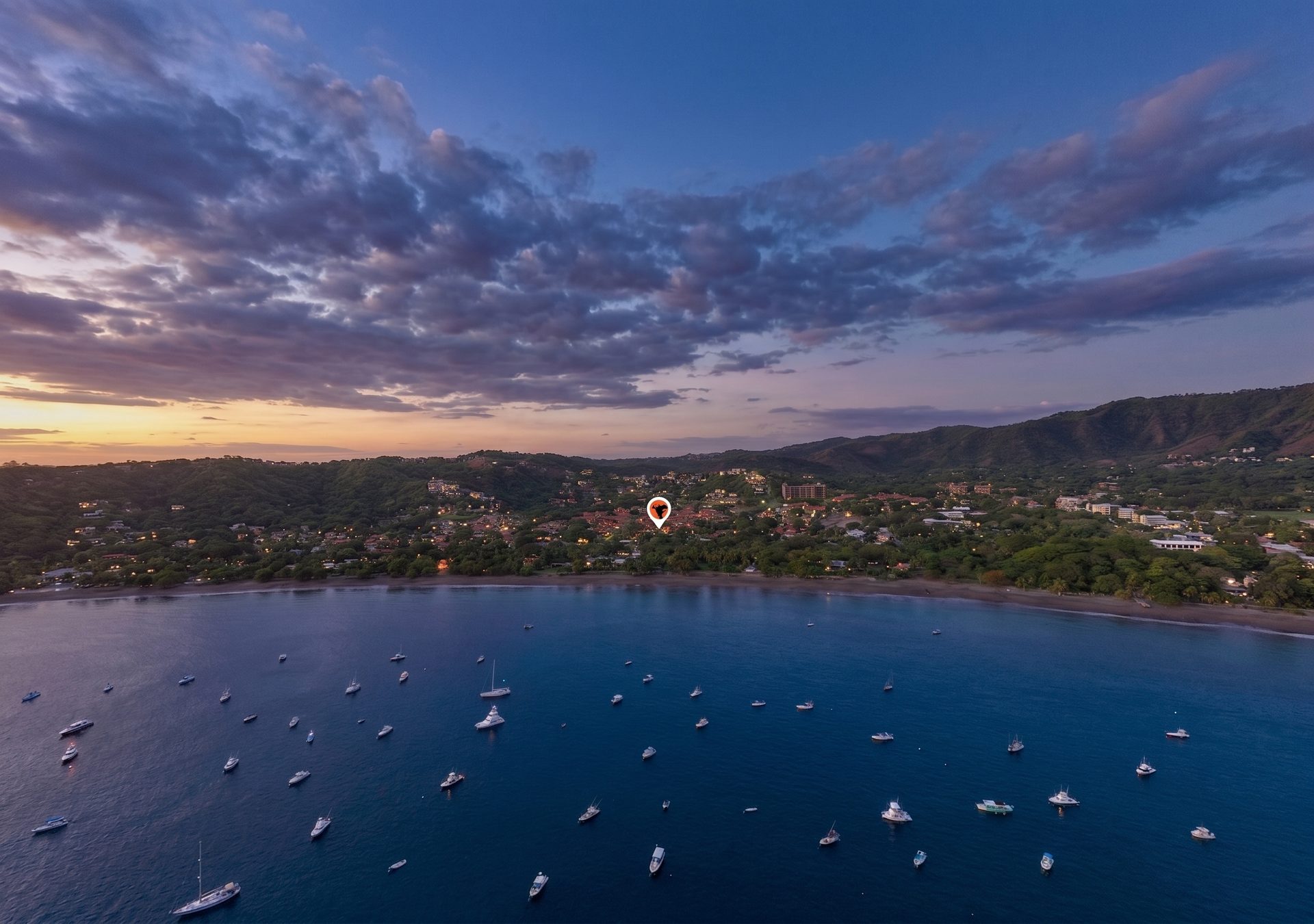
Guanacaste's international airport in Liberia (LIR) has direct flights from more than a dozen US cities, which is the single biggest reason the Gold Coast has become the American choice. Playas del Coco is the most complete town and the strongest rental market; Ocotal and Playa Hermosa are quieter neighbors ten minutes away; Coco Bay Estates and Pacifico are the gated communities most Americans end up touring first; and Tamarindo, an hour south, draws the surf crowd. Our community guide compares them, and our current listings show what each looks like at today's prices.
The mistakes we see most
Wiring money outside escrow. Skipping the water letter on a lot. Assuming a beachfront listing is titled when it is concession. Buying through a corporation without asking a US CPA about Form 5471. Trusting a listing price when the same property is advertised elsewhere for less. Every one of these is avoidable with a 30-day due-diligence period and a local team that has done this many times. Ours has, and we live here.
Frequently asked questions
Can a US citizen buy property in Costa Rica?
Yes. Foreigners have the same rights as Costa Rican citizens to own titled property, with no residency requirement. A passport and a tourist entry are enough to sign a deed. The only restrictions apply to beachfront concession land inside the 200-meter Maritime Zone and a 2-kilometer strip along the national borders.
What are closing costs in Costa Rica?
About 3.5 to 4 percent of the purchase price: a 1.5 percent transfer tax, roughly 0.85 percent in registry stamps, notary and legal fees of about 1 to 1.25 percent plus VAT, and an escrow fee. Buyer and seller commonly split them 50/50, though it is negotiable. The seller pays the real estate commission.
Can Americans get a mortgage in Costa Rica?
It is possible but slow and expensive for non-residents, with 30 to 50 percent down payments and rates well above US levels. Most Americans pay cash, use a home-equity line on their US property, or negotiate seller financing, which typically runs one to five years at 6 to 8 percent with a large down payment.
Do I have to report a Costa Rican property to the IRS?
Owning the property itself is not reportable, but rental income must be reported on your US return, a Costa Rican bank account may trigger an FBAR if your foreign accounts exceed US$10,000, and holding the property through a Costa Rican corporation usually requires Form 5471. There is no US-Costa Rica tax treaty, so you rely on the foreign tax credit.
Do I need residency to buy property in Costa Rica?
No. Americans can own property and visit for up to 180 days at a time as tourists. If you want to live here full time, investing US$150,000 or more in real estate can qualify you for investor residency, and pensionado and rentista categories exist for retirees and people with stable income.
This guide is general information from a licensed real estate agency, not legal, tax, or immigration advice. Laws, thresholds, and rates change; confirm current figures with your attorney and accountant before you act.