Wildlife You Will Actually See on the Gold Coast
An honest field guide to the Guanacaste wildlife that really shows up around Playas del Coco, from the team that lives here.
The Guanacaste wildlife you will actually see includes howler monkeys, black spiny-tailed iguanas, white-faced capuchins, magpie-jays, and squawking parakeets, often from a pool deck in Playas del Coco. Sloths and toucans are rare on this dry coast. Sea turtles, crocodiles, and huge flocks of waterbirds live within a short day trip.
We manage 60+ vacation rentals in Coco and Ocotal, so we hear the same question from guests and owners every week: what animals will I really see here? Not the brochure version. The real one. A few years ago we published a broad Wildlife of Guanacaste overview. This post is the updated, honest version, built from what actually shows up at the properties we manage.
Why does the Gold Coast look different from the Costa Rica postcards?
Most Costa Rica wildlife photos come from rainforest. Guanacaste is not rainforest. It is tropical dry forest, a rarer and more threatened ecosystem, and that changes which animals you see. The Area de Conservacion Guanacaste, a UNESCO World Heritage Site since 1999, protects about 147,000 hectares here, including what UNESCO calls the best dry forest habitats from Central America to northern Mexico.
Costa Rica as a whole holds around 6 percent of the planet's biodiversity, with roughly a quarter of the national territory under protection, according to the country's official tourism board. Guanacaste wildlife leans toward animals that handle heat and a long dry season: iguanas, monkeys that eat leaves, and birds of open woodland. If your dream is a sloth in every tree, we will be straight with you: that is the wetter south, not here. What you get instead is wildlife you can see clearly, because for half the year the trees drop their leaves and hide nothing.
Do howler monkeys really wake you up at 5 a.m.?
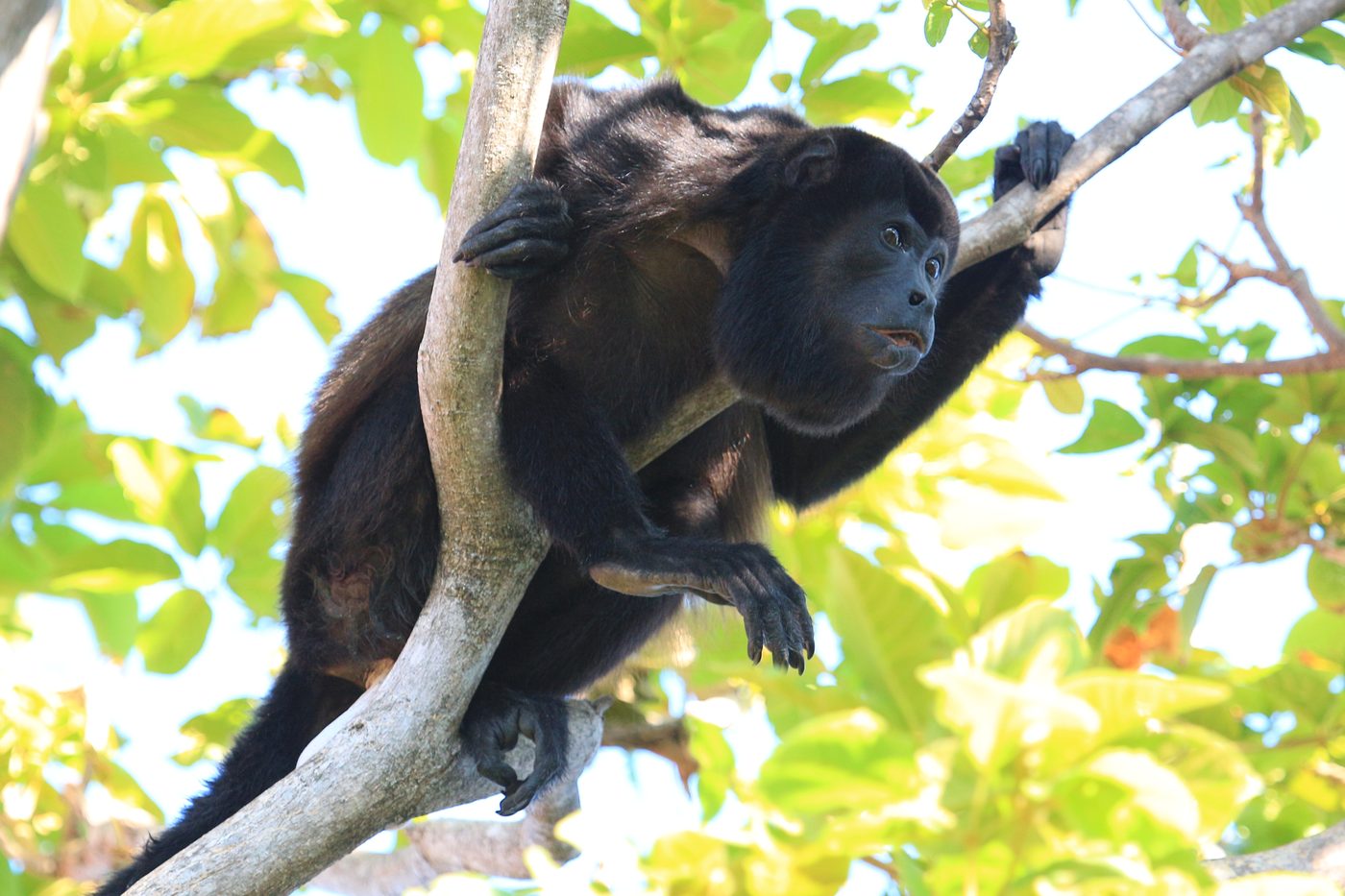
Sometimes, yes, and most guests end up loving it. Mantled howler monkeys are the animal you will hear before you see. According to the Smithsonian's National Zoo, a howler's call can carry about 3 miles (4.8 kilometers) under the right conditions, which makes howlers among the loudest land animals in the Americas. The roar sounds like something much bigger than a monkey. It is usually a troop marking its territory at dawn or answering distant thunder.
Around Coco and Ocotal, howler troops move along tree lines and green corridors between neighborhoods. At several of the hillside homes we manage, a troop passes through the same trees a few times a week, feeding on leaves and resting through the heat of the day. White-faced capuchins turn up too, mostly near larger patches of forest. Two house rules keep everyone safe: never feed monkeys, and keep screens or doors closed if capuchins are around, because they are clever and they will explore an open kitchen.
What is that big gray lizard on the pool deck?
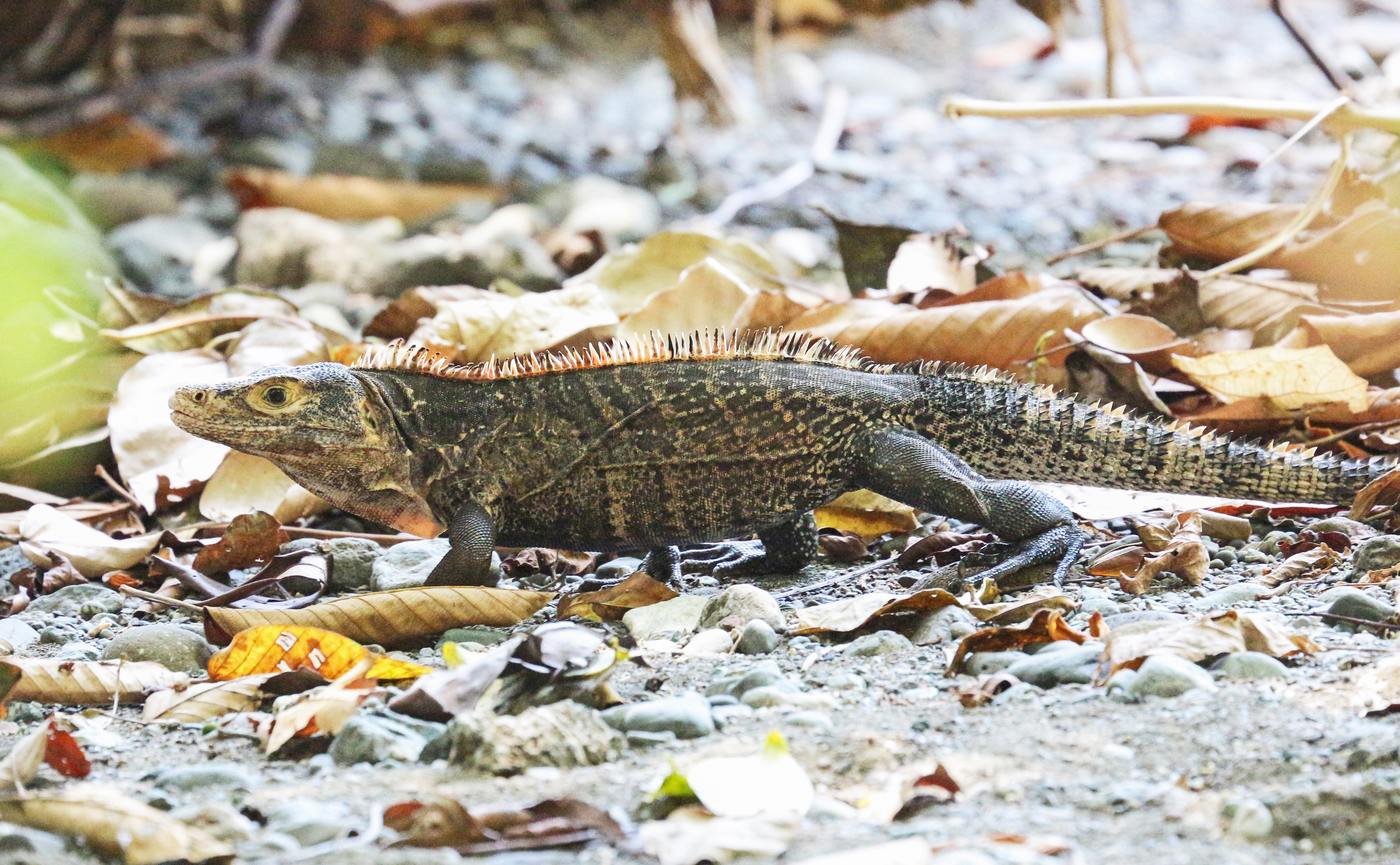
That is almost certainly a black spiny-tailed iguana, called a garrobo locally. They are the most reliable wildlife sighting in Playas del Coco, sunning on rocks, walls, and pool decks through the morning. Males can look intimidating, with spiky crests and a push-up threat display, but they are not dangerous to people. They mostly eat plants, flowers, and fruit, and they sprint for a burrow the moment you walk toward them.
Green iguanas live here too, usually higher in the trees and greener (though big males turn orange in breeding season). Guests confuse the two constantly. The simple rule: gray and on the ground, garrobo; green or orange and up a tree, green iguana. Neither wants anything to do with you, though a garrobo will absolutely steal papaya off an unattended breakfast table. We speak from experience at more than one rental.
Which birds show up without booking a tour?
Guanacaste is generous with birds, even in town. From a typical terrace in Coco or Ocotal you can expect white-throated magpie-jays (big, bold, blue, with a curled crest and no fear of your breakfast), noisy flocks of orange-fronted parakeets at dawn and dusk, hummingbirds working any flowering hedge, and groove-billed anis rattling in the scrub. Over the bay, brown pelicans glide in formation and frigatebirds hang on the wind. In shadier gardens, turquoise-browed motmots sit still on low branches, swinging their pendulum tails.
Serious birders use Coco as a base and day-trip to the wetlands. Casual birders just need coffee and a chair. We tell owners that a single flowering tree or a shallow bird bath does more for guest reviews than most upgrades, because animals in Playas del Coco are part of what people came for.
What wildlife is worth a day trip from Coco?
The headline act is sea turtles. At Ostional National Wildlife Refuge, about two hours south, olive ridley turtles come ashore in mass nesting events called arribadas, in some months by the tens of thousands, with the largest events in September and October. Local guides are required, and the spectacle is worth planning a trip around. Leatherbacks also nest near Tamarindo in the dry season months, though in much smaller numbers than decades ago.
Inland, Palo Verde National Park concentrates waterbirds, crocodiles, and monkeys along the Tempisque River, and a boat tour there is the densest Guanacaste wildlife outing you can book from Coco. Rincon de la Vieja and the Santa Rosa sector of the Guanacaste conservation area add volcano trails, dry forest, and a real chance at coatis, deer, and peccaries. One honest caution: large crocodiles live in river mouths and estuaries along this coast, including near popular beaches, so never swim near an estuary and keep dogs away from river edges.
What will you probably not see on the Gold Coast?
We would rather set expectations than oversell. Sloths are rare around Coco; they favor wetter forest, and a sighting here is a genuine event. Toucans and scarlet macaws are uncommon in the immediate area, though macaw sightings have been slowly increasing in parts of Guanacaste. Jaguars and other big cats live in the large protected areas, but seeing one is extraordinarily unlikely. If daily sloth photos are the goal, the Caribbean coast or the southern Pacific will fit better, and we say that as people who chose this coast anyway. What Guanacaste trades away in rainforest species it returns in visibility, sunshine, and monkeys you can set your watch by. It is one of the things that makes Playas del Coco different from the postcard version of Costa Rica, and we think it is a fair trade.
Does the season change what you see?
Very much. In the dry season, roughly late November through April, trees drop their leaves and animals concentrate around water, so spotting is easy even from a car. Howlers cluster in the evergreen trees along creeks, and iguanas are everywhere. In the green season the landscape turns lush, insects and frogs wake up, birdsong doubles, and the turtle arribadas build toward their September and October peak. There is no bad season for Guanacaste wildlife, just two different shows. Our guide to the best time to visit Costa Rica covers the tradeoffs month by month.
If you are thinking about owning here, wildlife is not a footnote. Guests mention monkeys and magpie-jays in reviews far more often than granite countertops. Browse our current vacation rentals to see the settings for yourself, or send us a message and we will tell you honestly which neighborhoods get the most visits from the local troop.
Frequently asked questions
Are there monkeys in Playas del Coco?
Yes. Mantled howler monkeys are the most common, moving through tree lines and green corridors around Coco and Ocotal, and you will usually hear their dawn roar before you see them. White-faced capuchins appear near larger forest patches. Never feed monkeys, and keep doors closed when capuchins are nearby, because they will investigate open kitchens.
Are the big iguanas in Guanacaste dangerous?
No. The gray lizards on pool decks and walls are black spiny-tailed iguanas, known locally as garrobos. They mostly eat plants, flowers, and fruit, and they run for a burrow when approached. Green iguanas, seen higher in trees, are also harmless. Do not hand-feed them; they may bite fingers by mistake and feeding makes them pushy.
When can you see sea turtles nesting in Guanacaste?
Olive ridley turtles nest at Ostional National Wildlife Refuge in mass events called arribadas, which happen in most months and peak in September and October, when tens of thousands can come ashore over a few nights. A certified local guide is required. Leatherbacks nest near Tamarindo during the dry season, in much smaller numbers.
Cover photo: Paul Harrison, CC BY-SA 4.0, via Wikimedia Commons · Photo: Bernard Gagnon, CC0, via Wikimedia Commons